Google translates the original post as:
Last week (13.10) I received the Ruuvi Air air quality meter I ordered. I have purchased the following combo for our apartment:
Ruuvi Gateway
RuuviTag Pro 4in1 X 2
RuuviTag 4in1 X 1
RuuviTag 3in1 X 2
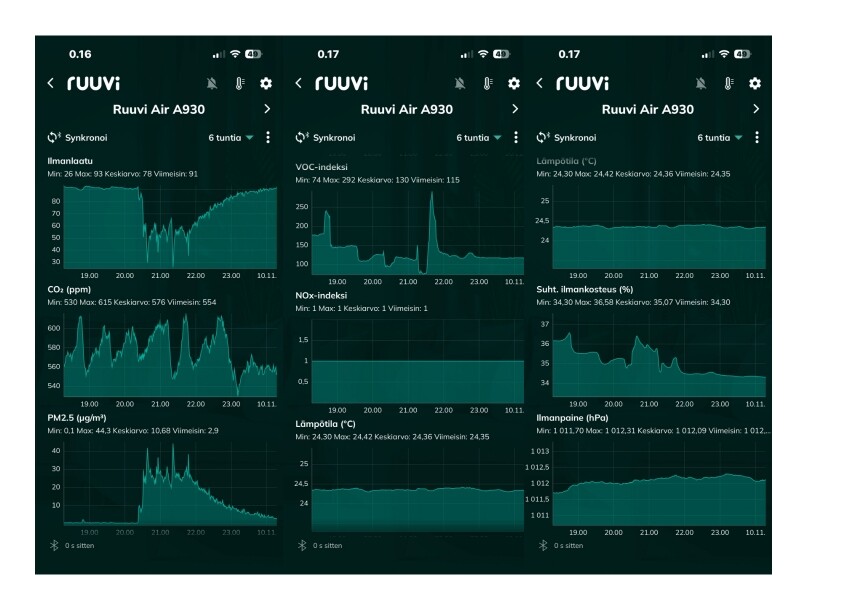
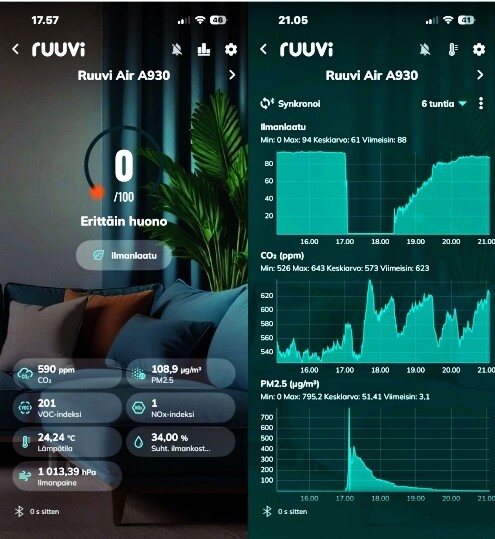
The meter worked fine until this morning. This morning it showed a red indicator light, the air quality was poor, sometimes showing zero. The apartment has mechanical ventilation, which works normally. There was no external reason for the deterioration of the air quality. But… It was cold outside. There are two Duux Neo Smart humidifiers in the apartment (ultrasound, anti-limescale filter), which had been turned on. The reason for the deterioration of the air quality was the high value of fine particles (PM2.5). I turned off the humidifiers, and the air quality slowly began to improve. I use an electronic cigarette, using which under the hood raises the same value, but quickly returns it to normal. Humidifiers quickly lower the air quality to poor, and very slowly return it to good.
Marko replied Thanks for your message. This is a well-researched topic, by the way, it would be better to use something other than tap water in a humidifier, humidifiers produce very small mist, which can indeed increase PM levels. Attached are publications from a couple of universities on the subject.
TapaniV added:This is one of the reasons why I prefer the so-called traditional boiling water solutions for humidifiers. I haven’t turned on the Ufox yet since the Ruuvi Air came into the house, but the assumption is that turning it on only improves the room air, not worsens it  .
.
JSt59 5d @Marko Thanks for the reply I didn’t find any mention of restrictions on the use of humidifiers… As a regular nerd, I don’t read English-language university studies, not even as a hobby. I am aware that distilled water (battery water) should be used in humidifiers. When a two-story terraced house has mechanical ventilation, many liters of water are consumed per day in winter (battery water approx. 1€/liter). The humidifiers I use have filters that are intended to remove limescale and impurities. I found a post by the pseudonym @huppu: “In a terraced house, I installed Ruuvi Air in the bedroom. In the evening, I took a sauna and after taking a sauna, the humidity from the sauna also spread to the bedroom. Ruuvi Air showed for a while that the air quality deteriorated from 79 –> 29. Humidity affects the transport of small particles”. Should battery water be used in the sauna too?
Here’s a picture of what the statistics show about having a humidifier on:[See 3 images]
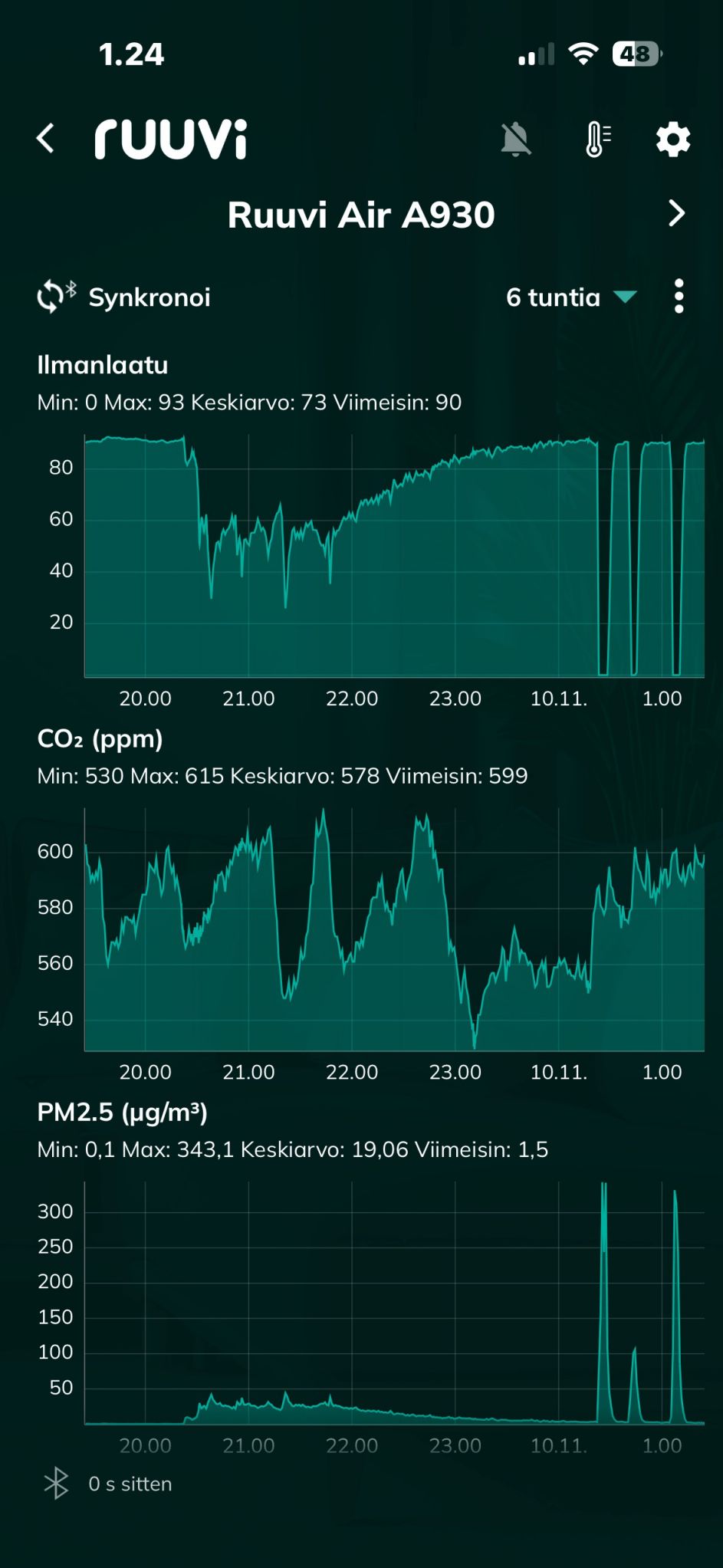
When the humidifier is turned off, it seems that the recovery takes a surprisingly long time compared to the recovery from particles caused by e-cigarette use (peaks at the end of the table):
For example, would it be possible to have an on/off function for PM2.5 measurement? Without it, our air quality measurement will be bad all winter.
Otherwise, the devices are excellent!
V12 added: In ultrasonic humidifiers, water is dripped into the device’s exhaust air. This means that water enters the air as droplets, which interfere with particle measurements. They appear as false positives, or correct ones, but are not solid particles. These small water droplets will of course evaporate over time, but evaporative humidifiers produce moisture as water vapor. Humidifiers that produce air by other means than evaporation are also susceptible to spreading microbes and, for example, water impurities into the air. Particle measurement in air and other gases is a field of science in itself, and in order to obtain reliable results, you have to use slightly more expensive equipment than can be installed in such a multifunctional device that costs around €100. Those “slightly more expensive” devices cost from tens of thousands to well over a hundred thousand, and you may also have to purchase sample processing equipment.
I can’t find anything about RuuviAir’s particle measurement method, but the safety data sheet states that the device contains a laser source, so it is likely an optical particle detector.
Otso responded:We have considered the possibility of showing different indices on Air, but at the launch stage we still have fixed air quality calculated from fine particles and CO2. I don’t dare to promise yet what new features and in what order we will develop, we will listen to feedback and when we know which are the most desired features we will start developing them.
Thanks for the idea though, this will help us prioritize further development.
JSt59:
@otso Thanks for the answer and positive attitude.
From my point of view, the most important values that I want to know as a resident are CO2 and relative humidity. When mechanical ventilation works with speed controls, it is good to know when it should be adjusted harder.
This has already worked during a short period of use: when there were more people in the apartment and the meter started to show yellow due to the increase in CO2, increasing the ventilation speed quickly returned the light to green. The TagAir device saves electricity and hearing nerves.:grinning_face: There is no need to keep the ventilation too loud unnecessarily.
My intention was to buy my own TagAir devices for the bedrooms, but I have to wait...
StefanA: We are Stadler Oscar brand humidifiers which are based solely on the evaporation of water through a paper cell. These do not raise PM values at all.
V12 Hmmm…. Constantly wet paper with water evaporating. Is possible paper mold a problem?
JSt59 StefanA So should we replace the humidifiers that have been doing a good job with their filters so far? And the wife whose brown sauce made the meter go red for three hours despite all the attempts at ventilation. 

.